
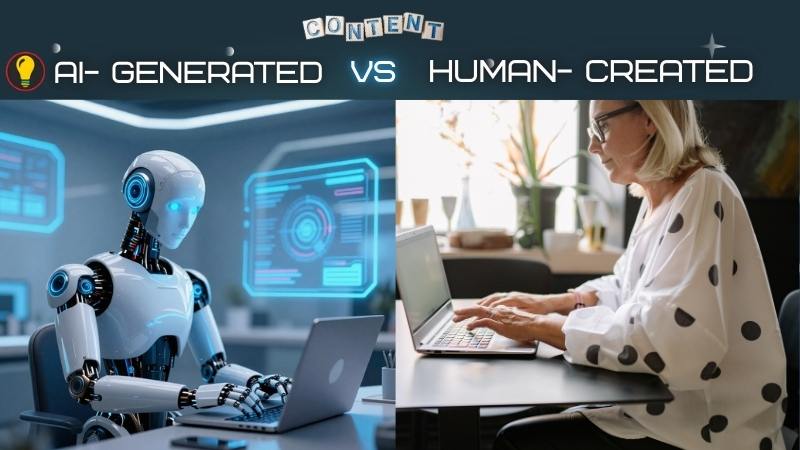
Scrolling social media, opening a blog, checking product descriptions, and reading email content are shaping almost every digital experience. But there’s one big question creators and marketers are asking.
Which is more powerful: AI-generated content or human-created content?
Is artificial intelligence replacing writers?
Is human creativity still powerful?
Or is the future something in between?
So, let’s break it down in simple words, clear thoughts, and a real-world perspective.
The Rise of AI Content in 2026
Over the last few years, AI tools have been growing rapidly. There are various platforms like ChatGPT, Gemini, Claude, Jasper, Copy.ai, Grammarly, and many others that have made it possible to generate content, articles, captions, descriptions, and even scripts so easily within seconds.
Yes, this is the fact about AI content nowadays:
- Faster than ever
- More structured
- More SEO-friendly
- Smarter with data
- Better at understanding search-oriented
And also, businesses are liking AI because:
- It saves time
- It reduces cost
- It scales content production
- It helps with keyword research
- It generates drafts instantly
For example, if a company wants 100 product descriptions in one day, AI can do that within minutes. If a startup needs 30 blog ideas in 10 minutes, AI can generate them easily.
From an efficiency perspective, AI is powerful.
But efficiency is not everything.
What is AI Generated Content?
AI-generated content is content created using machine learning models trained on large amounts of data. These models analyze patterns, language structures, and user intent to generate text that sounds like a human.
This is how AI works by their:
- Studying billions of words
- Learning sentence patterns
- Predicting what word should come next
- Generating complete responses
It doesn’t “think” like a human. It predicts based on data, and that’s an important difference because AI doesn’t have personal experiences, emotions, or opinions. It creates content based on patterns and probability.
What is Human-Generated Content?
Human-generated content is created by real people, along with the use of their:
- Personal experiences
- Emotions
- Creativity
- Critical thinking
- Real-life observations
And the most important thing is E-E-A-T. Only humans can fulfill it better, as they don’t just write, they feel.
When a human writes about failure, growth, love, struggle, business challenges, or success, they use their own depth, experiences, real stories, and emotions behind the words.
Why AI Content Is Everywhere in 2026
There are clear reasons why AI content has become so common:
1. Speed
AI can write a 1000-word blog in seconds, but humans may take hours. In competitive industries, speed matters more to maintain consistency than others.
2. Cost-Effective
Hiring experienced writers can be expensive, but AI tools are subscription-based, and they are available in affordable price and some even free for startups.
3. SEO Optimization
AI tools are trained to include trending keywords, optimize headings, improve readability, and structure content for search engines.
Nowadays, SEO is more data-driven than ever. AI understands patterns in ranking content and can generate SEO-friendly drafts quickly.
4. Content Demand Explosion
Businesses now need content for:
- Blogs
- Social media
- Email marketing
- YouTube scripts
- Product pages
- Landing pages
- Ads
The Problem with Pure AI Content
AI is powerful, but it has some limitations.
1. Lack of Real Emotion
AI can mimic emotion, but it doesn’t truly feel. Sometimes, while reading, we can easily recognise AI content by its:
- Robotic style
- Generic things
- Repetitive patterns
- Too structured sentences
2. No Real-Life Experience
AI cannot say, “I failed in my first startup and learned this lesson.” Authenticity builds trust, and AI struggles here because it never lived that experience. Readers can sense when something is lacking.
3. Over-Optimization
In 2026, search engines are smarter. They don’t just rank keyword-stuffed content, but they reward:
- Helpful content
- Experience-based writing
- Original insight
- E-E-A-T (Experience, Expertise, Authority, Trustworthiness)
AI content without human editing may sound perfect, but it lacks depth, real emotions, and experiences.
4. Similarity Risk
Since many people use AI tools, there is a risk of content sounding similar across websites that reduces uniqueness.
Why Human Content Still Wins Trust
Despite the AI boom, brands with a strong human voice are building deeper connections.
1. Storytelling Power
Storytelling creates emotional bonding. Even in 2026, storytelling marketing is stronger than ever, and humans tell stories better. People remember stories, not just information, and humans tell stories better.
2. Emotional Intelligence
Humans understand:
- Humor
- Sarcasm
- Cultural context
- Social sensitivity
- Tone variations
AI is improving, but humans naturally understand these layers.
3. Creativity & Innovation
AI predicts based on past data, while humans imagine the future. Creative campaigns, viral trends, and unique brand voices still depend on human thinking.
4. Trust Factor
Audiences trust:
- Personal experiences
- Transparent opinions
- Honest reviews
We know trust is currency, and brands that sound human win loyalty.
AI vs Human Content in SEO (2026 Perspective)
Search engines in 2026 became smarter and more advanced. They just focus on helpful content with depth, real-life examples, experiences, emotional connection, brand tone, and user intent.
While AI can help with finding the perfect title for the content, high research keywords, content structure, outlines, and meta descriptions.
The best-performing content in 2026 is usually AI-assisted but human-edited.
Industries Where AI Performs Best
AI content works very well in:
- Product descriptions
- Technical documentation
- Data summaries
- Basic informational blogs
- FAQ sections
- Automated reports
In these areas, clarity and speed matter more than emotion.
Industries Where Humans Perform Best
Human content performs better in:
- Personal development blogs
- Health & wellness stories
- Brand storytelling
- Opinion articles
- Case studies
- Thought leadership content
When depth and trust matter, humans lead.
The Real Winner in 2026: Collaboration
The debate “AI vs Human” is not about replacement anymore. It’s about collaboration.
In 2026, the smartest marketers use AI as a tool, not a replacement.
Think of AI as:
- Assistant
- Research partner
- Draft generator
- Idea machine
And humans are:
- Editor
- Storyteller
- Strategist
- Emotional intelligence provider
When both work together, content becomes faster, authentic, engaging, and SEO optimised. This combination wins.
How Businesses Should Use AI in 2026
Step 1: Use AI for Research
- Blog outlines
- Keyword suggestions
- Competitor analysis
- Content ideas
Step 2: Draft with AI
- Create layouts for the topic.
- Create a basic structure quickly.
Step 3: Human Editing & Enhancement
- Personal insights
- Real examples
- Industry expertise
- Brand tone
- Emotional depth
Step 4: Fact-Check & Optimize
- Human review ensures accuracy and originality.
- Add some more human-toned sentences.
The Future of Content Careers in 2026
Many writers fear AI will replace them, but the reality is different.
In 2026, content creators who:
- Understand AI tools
- Improve editing skills
- Focus on storytelling
- Build personal brands
- Develop niche expertise
They are more valuable than ever because writers are evolving into:
- Content strategists
- AI content editors
- Brand voice specialists
- SEO consultants
What Do Readers Prefer in 2026?
Research and user behavior show that readers prefer:
- Clear language
- Simple explanations
- Real examples
- Honest tone
- Useful information
They don’t care if AI helped create it, but they care if it helps them. If AI content feels robotic, readers leave. If human content feels confusing, readers leave. The winner is helpful, readable, and authentic content. When you see the top SEO company, Candent SEO is the one that delivers the best combination of AI and human intelligence, delivering the best outcomes from a business perspective.
Final Thoughts
Neither AI nor humans alone. The best role is played by a balanced collaboration of both of them. The content world is not a battlefield between AI and humans. It’s an evolution.
If you want to succeed in content marketing today, you should learn how to use AI wisely. Because at the end of the day, technology may write words, but only humans build connections.
AI is not the enemy of writers. It’s a powerful assistant that can change the way of simplicity. Eventually, content converts into a creative world, along with AI and humans brainstorming.