
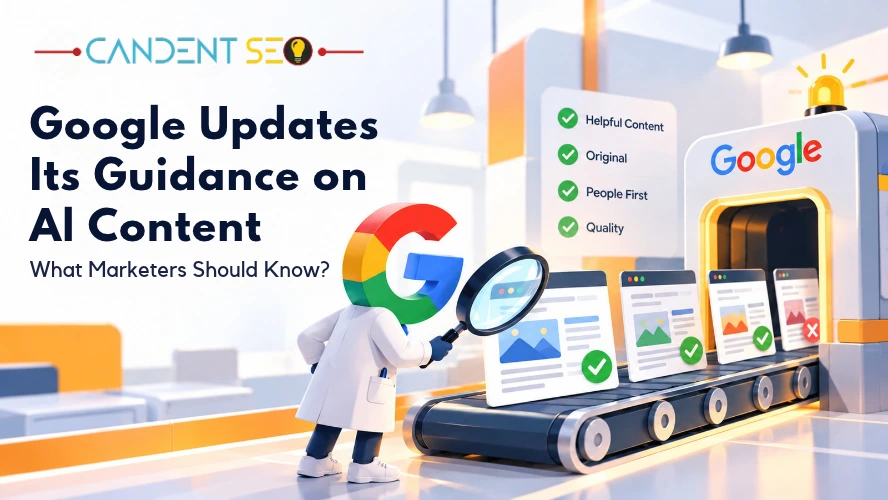
Google updated its Search Central guide on using generative AI content on 1 October 2026, adding information from its Search Quality Raters Guidelines.
If you’re a Patna business using AI tools for blogs, service pages or product descriptions, it’s a good nudge to check your content against the standard Google expects.
In this blog, we’ll go through what Google actually changed, what still holds true, where the real risks are, and the simple steps you can take this week to keep your content in good shape.
What’s New in Google’s AI Content Guidance?
Google’s Search Central changelog lists an update to the generative AI guide on 1 October 2026. Google says the change keeps its documentation in sync with the presentations it gives at developer events.
In the revised “accuracy, quality, and relevance” section, the update adds that:
- Generative models don’t retrieve facts, so outputs can contain inaccuracies, often called hallucinations.
- All AI-generated content should be manually fact-checked before publishing.
- That review also covers titles, meta descriptions, structured data and image alt text.
This is a documentation change. Google has not announced a new penalty or tied the edit to any algorithm update. For businesses investing in content marketing services in Patna, it reinforces the importance of publishing original, useful content that is carefully reviewed before going live.
What Stays the Same?
Although the October 2026 update adds new detail on fact checking, Google’s core approach to assisted content remains the same. Its guidance still welcomes AI as a helpful tool, as long as the content is made for people and not solely for search rankings.
These are some principles that continue to apply:
- AI assistance is not automatically a problem. Google says generative AI can be used to help with researching a topic and structuring original content.
- Mass producing content pages while neglecting to enhance user experience may lead to the violation of the policy against scaled content abuse.
- Content should be accurate, relevant, helpful and created primarily to help people.
- Facts, metadata and structured data need review before publishing.
- Telling readers about the use of AI could be favourable if the reader context is relevant, although an article does not need a public AI label.
Creating content with the help of AI is totally fine if the resulting work is to help people, is original, and is not only aimed at manipulating rankings. In fact, AI-generated content can rank on Google when it meets these standards.
Is Your Website at Risk?
A number of practices might be counted as quality issues or spam and further lead to policy violations. These include launching large volumes of content that is merely AI generated with little to no human effort put into them, rewriting competing articles without providing additional information or analysis, releasing inaccurate statements, statistical data that are not backed up and making pages solely for search visibility rather than serving the readers.
Risk does not depend on whether or not an AI was used but on the type of content and its production method. No one practice is assured to cause a drop in ranking, though; low-value content is a very weak foundation.
Risk depends on the content and how it is produced, not on whether AI was involved. No specific practice is guaranteed to cause a ranking drop, but low-value content is a weak foundation.
A consistent content strategy and accurate information across your website, listings and social profiles matter too, which is why businesses using a digital marketing company in Patna should keep every channel aligned.
How Does Candent SEO Use AI to Create Better Content?
At Candent SEO, our use of artificial intelligence is primarily to serve as a great resource, never as a source to rely solely on at the expense of professional judgement and thorough fact verification.
This is the workflow we recommend for every AI-assisted piece of content:
- Use AI for research, outlines, ideation and organising content.
- Verify facts, figures and dates against reliable primary sources.
- Add real expertise, local examples and original insights that AI cannot supply.
- Review the final draft for accuracy, readability, relevance and keyword stuffing.
- Make sure the page delivers an answer to the reader’s main question.
Although AI has the advantage of completing the groundwork in a fast and efficient manner, the quality and the final look of a piece are largely affected by the people involved in the process of going through and refining the content.
This process enables the team here at Candent SEO to be quite confident that the work is not only factual and original but it will also serve the readers in Patna and other regions well.
What Should Marketers Do This Week?
A brief evaluation of your AI-assisted content is sufficient to identify inaccuracies and poor quality issues before these problems get any worse. Here is a list of practical steps you can do over this coming week:
- Go through AI-assisted content that was recently published.
- Confirm or deny the reliability of the statement, data, dates or the source.
- Identify similar sections and substitute these for helpful, unique content.
- See if the article meets its search intent effectively through its content.
- Examine Search Console if there are changes in impressions, clicks, or performance that are unusual.
- Focus more on substantive upgrades rather than rewriting all AI-assisted pages.
In addition to keeping the website up to date with the latest changes, the content that is local or describing the services of the business must also be kept accurate. If you rely on a Google My Business service in Patna, make sure your Google Business Profile details match your website.
Using AI the Right Way
The update reinforces what Google has long said: quality, accuracy, originality and reader value matter most. Judge your content by what it offers users, not by whether AI helped write it. Review before you publish, and improve what falls short.
Use AI as a tool for your thinking, not a way to shortcut it! Companies which focus on what content can answer a real reader’s question will be in a good position even after Google changes the rules of the game again.
If you would like a second pair of eyes on your AI-assisted content, the Candent SEO team is always happy to walk you through a practical content review.